
A dangerous tree does not always look dangerous. Some of the trees that come down in Santa Ana events looked perfectly healthy from the kitchen window the day before. The trouble was inside the trunk, down at the roots, or up in the canopy where nobody was looking. Learning to read the warning signs is how you catch a hazard before it becomes an emergency.
Here is what our arborists look for when we assess whether a tree is a risk to your home, your family, or your property across La Verne, Claremont, and the surrounding Southern California communities.
Start at the ground and work up
A proper hazard assessment starts at the base of the tree, not the top. The root zone is where the most serious and least visible problems live, and roots are what hold the whole thing up.
- Soil heaving or cracking. If the ground on one side of the trunk is lifting, mounding, or cracking, the roots may be pulling loose. That is a serious red flag for whole-tree failure.
- Exposed or damaged roots. Cut, rotted, or severed roots, often from nearby construction or trenching, weaken the tree’s anchor. Damage done a year or two ago can show up as instability now.
- Fungus at the base. Mushrooms or shelf fungus on the roots or lower trunk usually mean decay is already inside the wood.
Check the trunk for structural problems
The trunk carries all the weight above it. When it is compromised, the whole tree is.
- Vertical cracks and seams. A crack running down the trunk points to a split forming inside. These are common failure points under wind load.
- Cavities and hollows. Knock on the trunk. A hollow or drum-like sound, or wood that feels soft when pressed, signals internal decay. A tree can tolerate some hollowing, but past a point the shell cannot hold the load.
- Bark falling away. Large sections of bark sloughing off on their own, revealing dry wood underneath, is a sign that part of the tree has died.
Look up at the canopy
The canopy tells you what the tree’s plumbing is doing and where the falling hazards are.
- Large dead limbs. Big deadwood branches, especially over a roof, driveway, or walkway, can drop without warning. This is one of the most common tree injuries and one of the most preventable.
- Hanging or broken branches. A limb that has cracked but not fallen, sometimes called a widow-maker, is a hazard waiting for the next gust.
- Sparse or one-sided growth. A thin canopy in season, or growth that is heavily weighted to one side, can point to internal decline or a balance problem that makes the tree more likely to fail.
Watch for the co-dominant stem problem
Many trees split into two large stems of roughly equal size, forming a V or a tight fork. When bark gets trapped in that union, the joint is weak, and it is one of the most common places a tree tears apart in a windstorm. If you have a large tree with a tight, deep fork, especially over a structure, it is worth a professional look. Sometimes the fix is cabling or weight reduction through pruning rather than removal.
The Santa Ana factor
In most of the country, tree risk is a slow, year-round question. Here it has a season. Santa Ana winds hit our foothill communities every fall and winter with sustained gusts that regularly top 40 to 70 mph, and they are the single biggest cause of tree failure in the region. A tree that stands fine all summer can fail the first time it takes a real wind load, especially if it has any of the defects above.
This is why a defect that would be low-priority elsewhere is worth taking seriously in La Verne, Glendora, San Dimas, and the surrounding areas. The wind that finds the weak spot is coming, on a schedule, every year.
Trees near targets deserve extra attention
Arborists talk about hazard in terms of two things: the likelihood a tree fails, and what it would hit if it did. A dead tree in the back corner of an empty lot is low priority. The same tree leaning over your bedroom, your driveway, or a power line is urgent. When you are judging risk, factor in what sits beneath the tree. A tree in contact with a power line is always a job for professionals and often a 24/7 emergency situation.
Some species fail more often than others here
Not all trees carry the same risk in our climate. Eucalyptus is notorious for dropping large limbs and whole trees in high wind, and it is one of the species we respond to most after a Santa Ana event. Tall palms can shed heavy fronds and, when diseased, fail at the crown. Pines and other shallow-rooted species are prone to uprooting when winter storms saturate soil that has been bone dry for months. If you have one of these species close to your house, it deserves closer attention than a slow-growing native oak in an open corner of the yard.
A simple check you can do today
You do not need special training to do a basic once-over. Walk the tree and look for three things. First, the lean: sight the trunk against something vertical like a fence post and note whether it looks like it has shifted. Second, the base: check for mushrooms, cracked or lifted soil, and any wobble. Third, the canopy: look up for large dead limbs and broken branches hung up in the crown. You can also lightly scratch a small branch. Green or moist under the bark means that part is alive. Brown and dry means it is dead. None of this replaces a professional assessment, but it tells you whether you have a reason to make the call.
What to do the moment you spot a hazard
If you find something that worries you, keep people and cars away from the drop zone until it is handled, especially the area a falling limb or trunk would reach. Never touch a tree that is in contact with a power line, and never try to cut down a compromised tree yourself. This is where most serious tree-work injuries happen. Call a professional, and if the tree is actively failing or already down, treat it as an emergency.
When you cannot tell, call a professional
A lot of dangerous trees pass a casual glance. Internal decay, root loss, and structural defects hide well, and the tools to detect them are not in most homeowners’ garages. If a tree is large, close to your house, or showing any of the signs above, the smart move is to get an expert set of eyes on it before you decide anything.
An ISA Certified Arborist can check for internal decay, evaluate the roots, and assess wind risk using formal Tree Risk Assessment methods, then tell you honestly whether the tree can be managed or needs to come down. Sometimes the fix is pruning and cabling. Sometimes it is removal. Either way, you stop guessing.
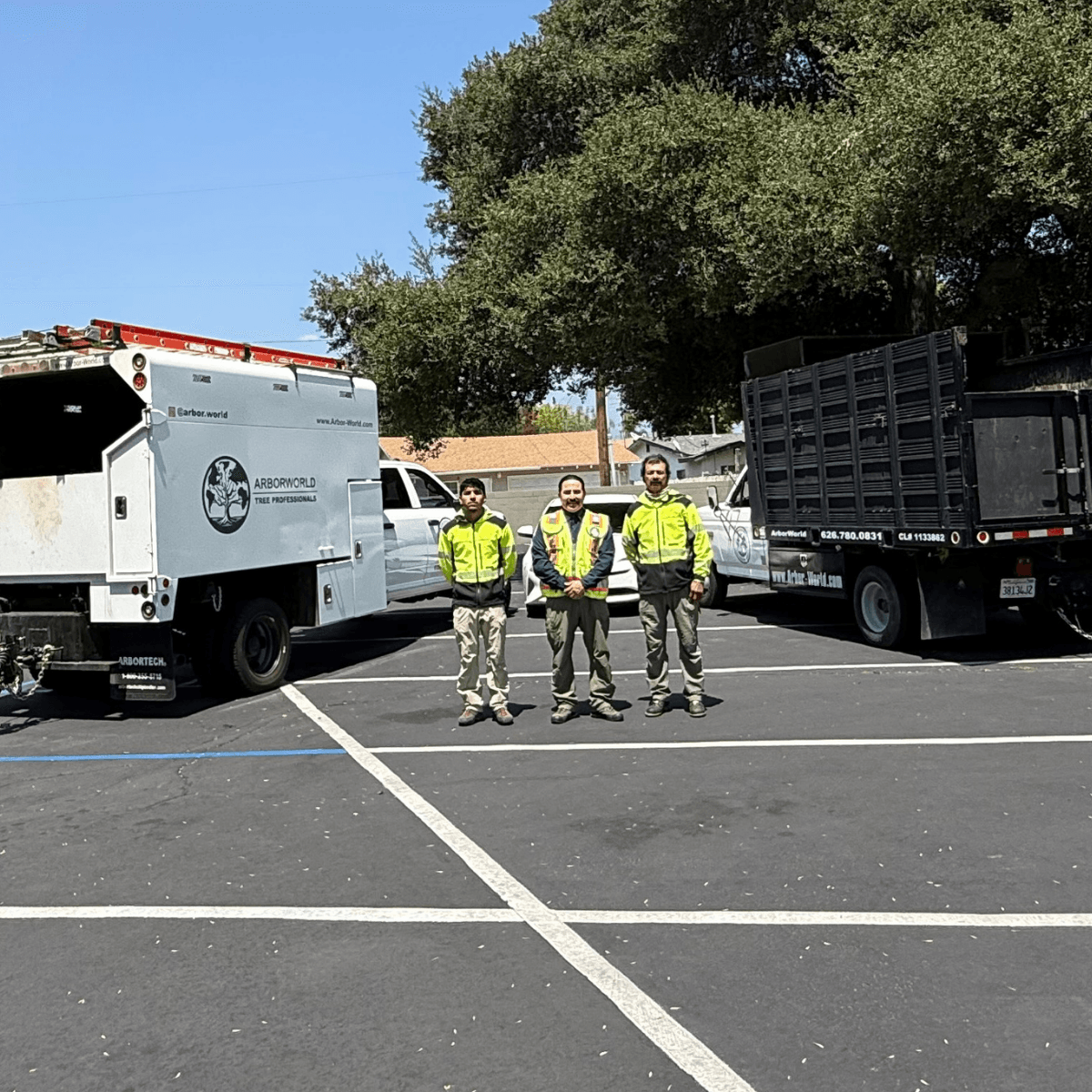
ArborWorld has assessed and handled hazardous trees across La Verne, Claremont, Upland, Rancho Cucamonga, and the surrounding Southern California communities for 23 years. If you have a tree you are worried about, call (626) 779-8786 or request a free estimate, and we will give you a straight answer.
Dangerous Tree Warning Signs: FAQs
How can I tell if a tree is dangerous?
Work from the ground up. Check the base for mushrooms, cracked or lifted soil, and any lean. Check the trunk for vertical cracks, cavities, or bark falling away. Then look up for large dead limbs and broken branches hung in the canopy. One sign alone is rarely a verdict, but several together mean it is time for a professional assessment.
What does a lean on a tree mean?
A lean matters most when it is new. Sight the trunk against something vertical like a fence post and note whether it looks like it has shifted. A long-standing, stable lean is often fine, but a fresh lean paired with cracked or heaving soil on one side can signal the roots are pulling loose, which is a serious red flag for whole-tree failure.
Are mushrooms growing on my tree a problem?
Often, yes. Mushrooms or shelf fungus on the roots or lower trunk usually mean decay is already working inside the wood, even when the tree still looks healthy above. Fungus does not always mean the tree must come out, but it is a clear reason to have an arborist check how far the internal decay has spread.
Why are trees in Southern California more likely to fail in fall and winter?
Santa Ana winds. They hit our foothill communities every fall and winter with sustained gusts that regularly top 40 to 70 mph, and they are the single biggest cause of tree failure in the region. A tree that stands fine all summer can fail the first time it takes a real wind load, especially if it already has cracks, decay, or deadwood.
Which tree species are most likely to be dangerous here?
Some species carry more risk in our climate. Eucalyptus is notorious for dropping large limbs and whole trees in high wind. Tall palms can shed heavy fronds and fail at the crown when diseased. Pines and other shallow-rooted trees are prone to uprooting when winter storms saturate dry soil. One of these close to your house deserves closer attention.
What is a co-dominant stem, and why does it matter?
Many trees split into two large stems of roughly equal size, forming a tight V or fork. When bark gets trapped in that union, the joint is weak, and it is one of the most common places a tree tears apart in a windstorm. A large tree with a deep fork over a structure is worth a professional look. Cabling or weight reduction is sometimes enough.
What should I do the moment I spot a dangerous tree?
Keep people and cars out of the area a falling limb or trunk would reach until it is handled. Never touch a tree that is in contact with a power line, and never try to cut down a compromised tree yourself, since that is where most serious tree-work injuries happen. Call a professional, and treat an actively failing or fallen tree as an emergency.
Can I assess a tree myself, or do I need an arborist?
A basic once-over, checking the lean, the base, and the canopy, tells you whether you have a reason to call. It does not replace a professional assessment. Internal decay, root loss, and structural defects hide well, and detecting them takes tools most homeowners do not have. An ISA Certified Arborist can evaluate internal decay, roots, and wind risk, then tell you honestly what the tree needs.