Removing a tree safely in Southern California means accounting for things most parts of the country don’t deal with – Santa Ana winds, year-round drought stress, fire risk, dense residential lots with houses just feet from mature trees, and a mix of native, ornamental, and palm species that each behave differently when they come down. ArborWorld has been handling tree removal across La Verne, and the San Gabriel Valley for 23 years, with ISA Certified Arborists on staff and 64 years of combined team experience between the crew.
How a Removal Actually Works
Every removal starts with a property walkthrough by an ISA Certified Arborist. We evaluate the tree’s lean, structural condition, decay points, and root health, identify everything within falling distance – house, pool, neighbouring fence, hardscape, hydro lines – and pick the method that matches the situation. There are three core approaches:
- Straight fell – felling the tree whole in one controlled drop. Only an option when there’s a clear landing zone roughly 1.5x the tree’s height, which on most La Verne lots simply isn’t there. Common on larger rural properties or open commercial parcels.
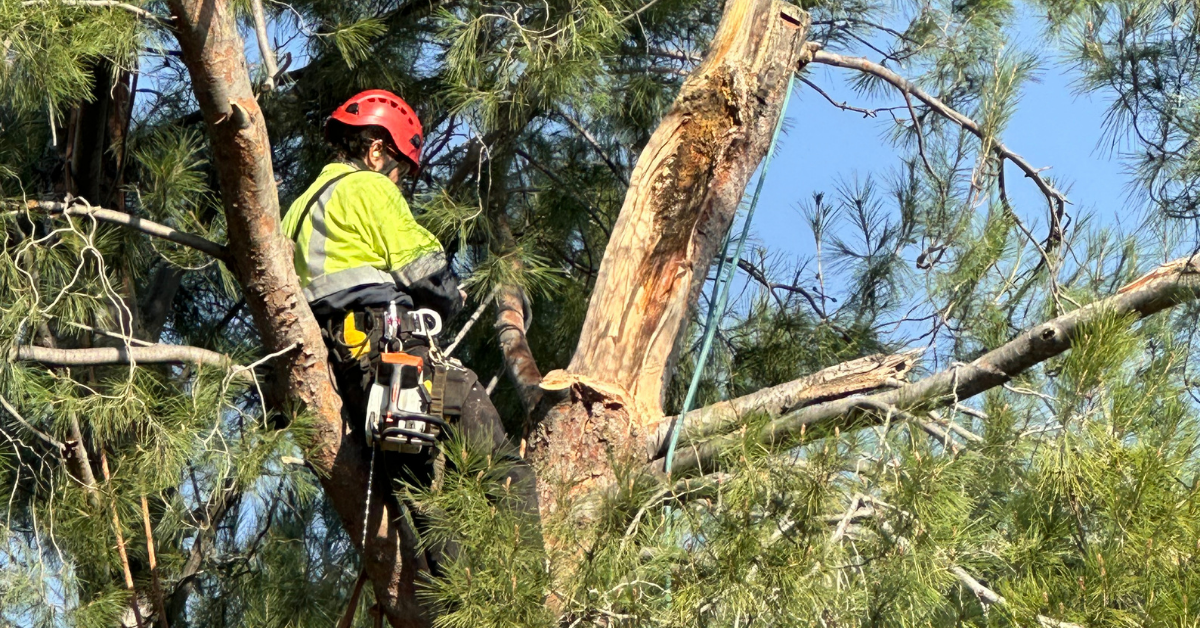
- Sectional dismantling – an ISA Certified Tree Climber takes the tree apart from the top down, rigging each section with ropes so it comes down exactly where intended. This is the method behind the majority of our residential removals across the San Gabriel Valley.
- Crane-assisted removal – for hazardous trees that can’t be safely climbed, trees over structures, or jobs where sectional work would take days. The crane lifts each piece cleanly out of the danger zone. Adds cost but often the safest and fastest method for large or compromised trees.
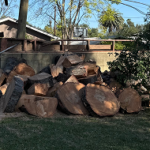
When the cutting is done, the cleanup is included – brush gets chipped on-site, larger wood is hauled off (or cut and stacked for you if you want it), and the area is left properly cleaned.
When a Tree Needs to Come Down
Not every problem tree needs to be removed. Sometimes pruning, cabling, root treatment, or pest management will fix the issue, and the right call is whatever keeps the tree if the tree can be safely kept. But certain signs indicate the tree is past saving and waiting becomes the more expensive option:
- Significant deadwood – more than 25 to 30% of the canopy is dead, leafless, or shedding bark in large sheets.
- Trunk decay – visible mushrooms or fungal conks, soft or hollow-sounding wood when tapped, deep vertical cracks running up the trunk.
- Sudden lean – a tree that’s leaning noticeably more than before, especially with freshly exposed roots on the upwind side. This is active root failure.
- Compromised root system – roots cut during recent construction, root rot from over-watering, soil heaving near the base, or visible root damage from grade changes.
- Storm or wind damage past saving – split unions, cracked trunks, or major limbs broken in ways that can’t be cabled or restored.
- Pest infestation past treatment – established shothole borer damage, mature pines with bark beetle galleries, or trees with extensive borer holes producing pitch tubes or frass.
- Palm decline past treatment – Fusarium wilt in Canary Island date palms, pink rot in queen palms, or palms with severe trunk softening and crown collapse.
- Wrong tree, wrong spot – eucalyptus near a house, large trees damaging foundations or pool decks, trees growing into power lines, or trees that have outgrown their location and can’t be relocated.
Hazardous and Crane-Assisted Tree Removals
Some trees are too compromised, too tall, or too close to a structure to take down by climbing. Hazardous removals are some of the most demanding work in the industry, and they’re where the difference between an ISA-certified crew with the right equipment and an underqualified operator with a chainsaw becomes serious. Trees with extensive trunk decay can fail under a climber’s weight. Storm-damaged trees are full of trapped tension that releases violently when cut. Trees over houses need every section lifted, not dropped.
For these jobs, we use crane-assisted removal. The crane handles the weight, the climber attaches each section before cutting, and pieces are set down in a designated drop zone instead of falling through the canopy. It costs more on the day – usually $1,500 to $4,000 added for the crane – but on the right tree it saves money overall by avoiding property damage and reducing total job time.
Stump Grinding
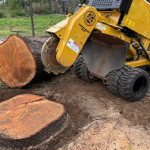
After the tree is down, the stump is the last thing in the way of a finished yard. We grind stumps below grade so the area is ready for replanting, sod, hardscape, or new construction. Grinding handles both the stump itself and the surface roots radiating from the base. Stump grinding is available as part of the removal or as a standalone service.
Permits and HOA Requirements
Tree removal in many San Gabriel Valley cities requires a permit before any work begins, particularly for trees within municipal limits, on commercial property, or for protected and heritage species. La Verne, Claremont, Pasadena, San Marino, Sierra Madre, and several other local jurisdictions all have tree protection ordinances. We’re familiar with the local rules, will flag whatever applies during the estimate, and can handle the permit application on your behalf. HOAs in many area communities have their own approval requirements as well – we’ll work with the management company when needed.
What’s Included in Our Tree Removal Service
- Free on-site estimate with a firm written quote.
- ISA Certified Arborist involved in every removal decision.
- Removal method matched to the tree and the site.
- Stump grinding available as part of the same job.
- Complete brush chipping and debris haul-off.
- Full property cleanup.
- Workmanship guarantee on every job.
- No-surprise pricing – what we quote is what you pay.
- Permitting handled when required.
New customer offers: 10% off any service over $500, or $100 off same-day hires. Military, senior, first-responder, and teacher discounts available. Flat-rate pricing and payment plans available for larger projects.
Service Area
La Verne, Claremont, Glendora, Pomona, Upland, Rancho Cucamonga, Diamond Bar, City of Walnut, West Covina, Covina, Pasadena, South Pasadena, San Marino, Altadena, Arcadia, Sierra Madre, Monrovia, Bradbury, and Glendale – across the San Gabriel Valley and surrounding LA County.