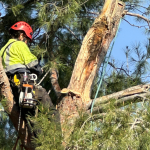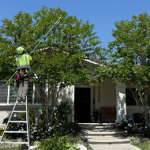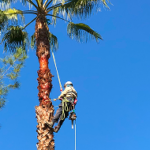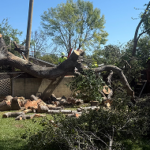
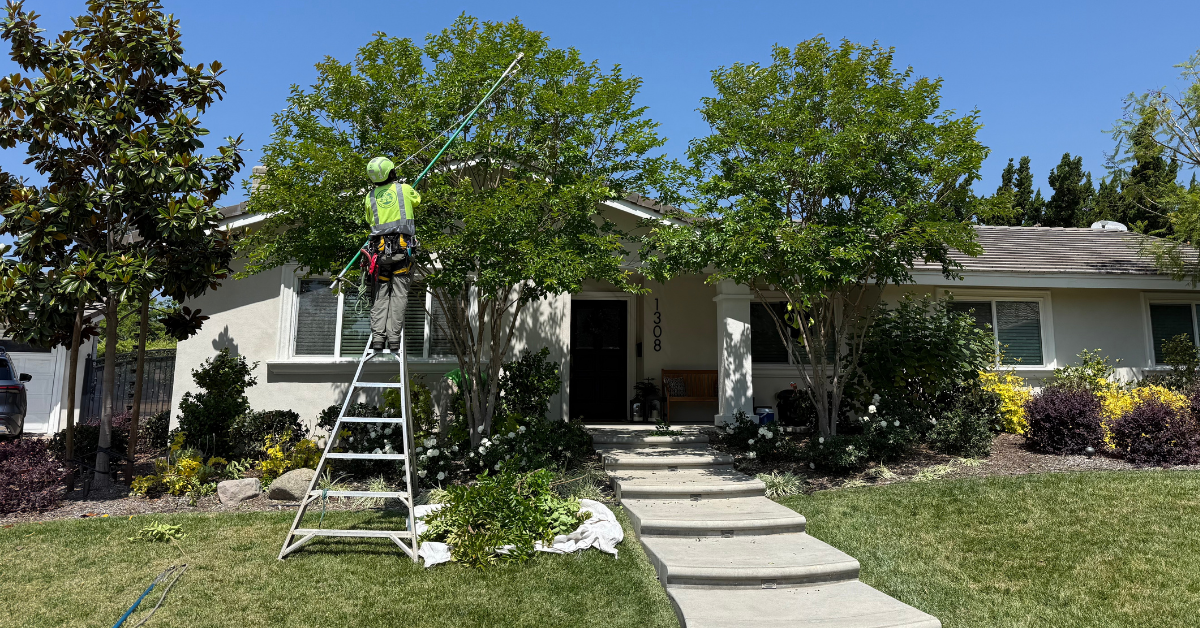
Proper trimming and pruning keep trees healthy, safe, and structurally sound – and in Southern California’s climate, where trees deal with year-round growth, periodic drought stress, Santa Ana winds, and intense summer heat, getting the cuts right matters more than most homeowners realize. Bad pruning creates problems that show up years later: weak regrowth, fungal entry points, structural failure under wind load. Done correctly, pruning can add decades to a tree’s useful life.
ArborWorld handles trimming and pruning across La Verne, Claremont, Pasadena, and the surrounding San Gabriel Valley. Every job is led by an ISA Certified Arborist.
- We never prune tree species outside of their recommended pruning season, helping protect long-term health and reduce unnecessary stress.
- All pruning tools are sanitized before every job to help prevent the spread of pests and tree diseases.
Trimming vs. Pruning – They’re Different Jobs
The terms get used interchangeably, but they describe different work with different goals:
- Trimming focuses on clearance, safety, and appearance – removing limbs that have grown into the wrong place (over the roof, into power lines, blocking sight lines), opening up the canopy for light, reducing weight on heavy lateral branches.
- Pruning focuses on the tree’s long-term health and structural development – removing dead, diseased, or weakly attached wood, shaping young trees to develop strong scaffold branches, opening the canopy for air movement, correcting structural defects before they become permanent.
Most jobs involve elements of both. The walkthrough during your free estimate identifies what each tree needs.
What We Do (And What We Never Do)
Pruning techniques that follow industry standards and protect the tree:
- Crown cleaning – removing dead, dying, diseased, and broken branches throughout the canopy.
- Crown thinning – selectively removing live branches to reduce density and improve air and light penetration, without over-thinning.
- Crown raising – lifting the lower canopy to provide clearance over driveways, walkways, vehicles, and sight lines.
- Crown reduction – properly reducing the size of a tree by cutting back to lateral branches that can take over as new leaders. Done correctly, not topping.
- Structural pruning – shaping young trees to develop a single dominant leader and well-spaced scaffold branches. One of the highest-value services available because it pays dividends for the next 50 years of the tree’s life.
Practices we never use because they damage trees:
- Topping – cutting the entire top off a tree to reduce its height. Triggers weak, dense regrowth and creates lasting damage. We never top, regardless of who asks.
- Lion-tailing – stripping all interior foliage and leaving only the tips of branches. Moves weight to branch ends and dramatically increases failure risk in wind.
- Flush cuts – cutting branches off flush with the trunk. Removes the branch collar where healing happens and creates an entry point for decay.
- Over-thinning – removing more than about 25% of the live canopy in a single year. Stresses the tree and often triggers weak regrowth.
Tree Trimming Timing in Southern California
Southern California’s climate doesn’t have a traditional dormant season the way colder regions do, which changes the timing rules. General guidelines for the most common La Verne species:
- Live oaks and other native oaks: avoid pruning between February and June to reduce risk of oak wilt and bark beetle attraction. Late summer through early winter is the safer window.
- Deciduous hardwoods (sycamore, liquidambar, ash, elm): late winter to early spring while still dormant, ideally before bud break.
- Fruit trees: most stone fruits are pruned mid- to late-winter; citrus is best pruned after harvest and before bloom.
- Eucalyptus: late winter to early spring, with extra care since cuts can attract longhorned borers – sterilized tools and proper timing matter.
- Palms: most palms can be trimmed year-round, though late spring before peak Santa Ana wind season is common for storm prep.
- Flowering ornamentals (jacaranda, magnolia, crepe myrtle): right after the main bloom, before next year’s flower buds form.
- Hazardous and storm-damaged limbs: any time of year, immediately.
Santa Ana Wind Prep Trimming
Santa Ana wind events bring sustained winds of 40 to 70+ mph through the San Gabriel Valley, usually in fall and winter, and they’re the leading cause of tree failure in this region. Trees that go into Santa Ana season properly trimmed are dramatically less likely to fail. Pre-season prep work targets the high-risk failure points:
- Dead and damaged limbs anywhere in the canopy – these are the first things to fail in high wind.
- Long, heavy lateral limbs over-leveraged on weak unions – these tear out under load.
- Tight V-shaped branch unions with included bark – the single most common structural failure point during high-wind events.
- Limbs hanging over roofs, driveways, pool enclosures, and parked vehicles – even healthy limbs in these spots create damage potential when they finally fail.
- Palms with hangers – old fronds that haven’t released and become projectiles in high wind.
- Crown weight reduction on top-heavy trees that catch too much wind.
Palm Trimming
Palms have their own pruning rules. Over-pruning (the so-called “hurricane cut” – stripping all but a few fronds at the top) actually weakens palms and makes them more vulnerable, not less, despite the name. It stresses the palm, attracts pests, and removes the food-producing fronds the tree needs. Proper palm trimming removes only dead and dying fronds, old fruit stalks and seed pods, and hangers, while leaving enough live frond mass for the palm to stay healthy. Different species have different needs – Mexican fan palms (washingtonias), Canary Island date palms, queen palms, king palms, and Mediterranean fan palms each have their own profile.
How Often to Prune
Most mature trees benefit from pruning every 3 to 5 years, though fast-growing species (silver maple, eucalyptus, certain pines) may need attention more often, and slower-growing species (live oak, valley oak) can sometimes go longer. Young trees benefit from lighter, more frequent structural pruning during their first decade in the ground – these early cuts shape the tree’s structure for life. The free on-site evaluation will tell you what your trees need and when.
What’s Included in Our Tree Trimming and Pruning Service
- Free on-site evaluation by an ISA Certified Arborist.
- Species-appropriate, season-appropriate cuts.
- ANSI A300 industry-standard pruning practices.
- Complete brush chipping and haul-off.
- Full cleanup before we leave.
- Workmanship guarantee and no-surprise pricing.
New customer offers: 10% off any service over $500, or $100 off same-day. Military, senior, first-responder, and teacher discounts available.
Service Area
La Verne, Claremont, Glendora, San Dimas, Upland, Rancho Cucamonga, Diamond Bar, City of Walnut, West Covina, Covina, Pasadena, South Pasadena, San Marino, Altadena, Arcadia, Sierra Madre, Monrovia, Bradbury, and Glendale – across the San Gabriel Valley and surrounding LA County.